
“Mooring” covers everything from a serviced marina berth with power and CCTV to a buoy in a tidal estuary you reach by dinghy. The differences matter: they change what you pay, what facilities you get, what boats fit, and whether you can live aboard. This guide covers each type, and what each one costs relative to the others.
Pontoon and finger berths
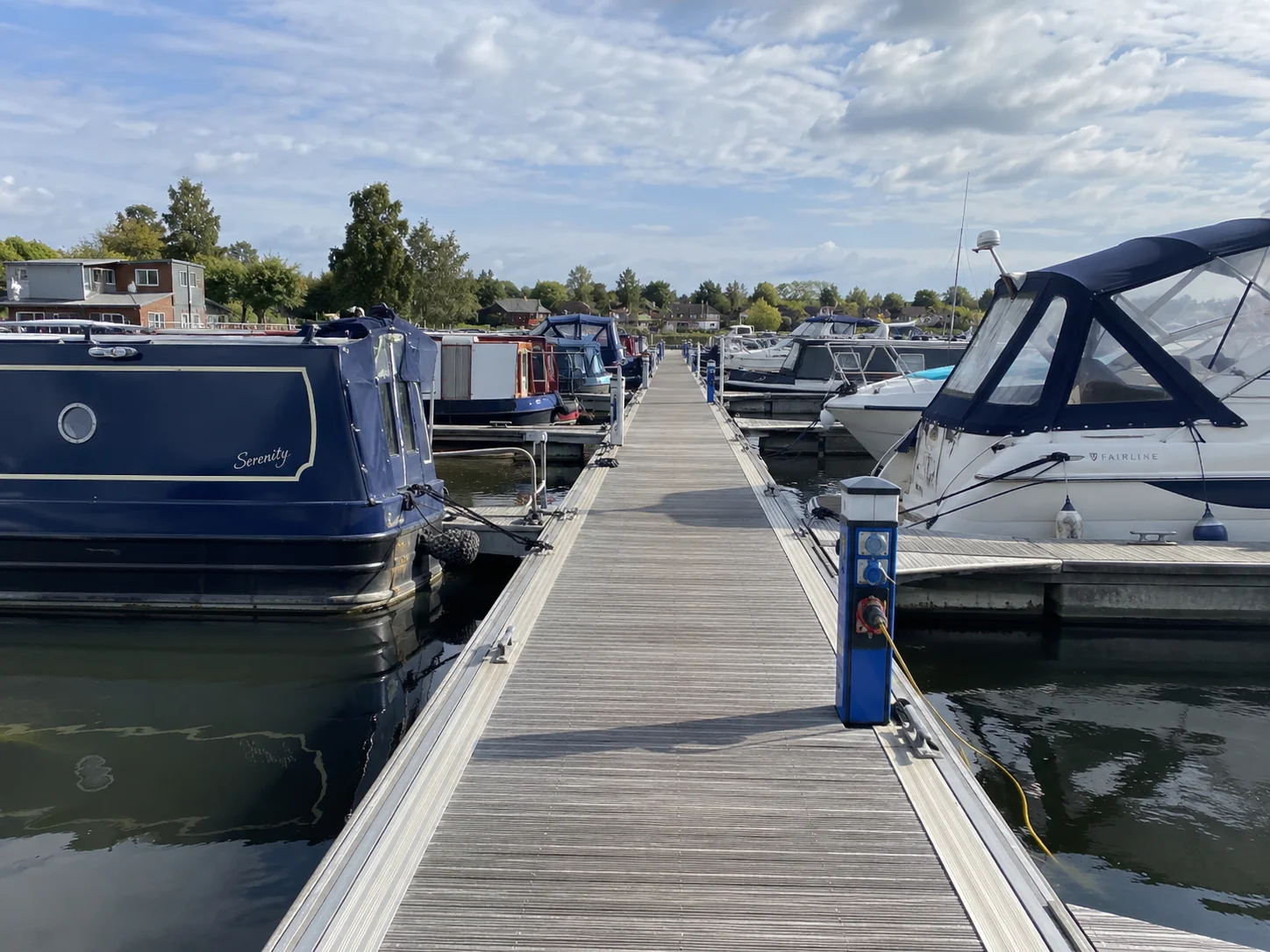
A floating pontoon berth. In a finger berth the boat sits in its own slot with a narrow walkway on one side; in an alongside berth it lies side-on to the pontoon or quay. Because the pontoon floats, the step aboard stays the same whatever the water level.
Usually the best-serviced option: shore power, water, Wi-Fi, showers, laundry and gated access are standard at most marinas. River marinas normally price pontoon berths per metre — £401 a metre for an annual contract at York Marina in 2026-27, £526 on the Thames at Val Wyatt, both including winter hard standing.
Best for: cruisers, yachts and owners who want full services and easy access.
Linear narrowboat berths
The most common inland arrangement — the boat lies alongside a bank, wall or long pontoon in its own marked length, rather than reversing into a slot. Easy to get in and out of single-handed, and no manoeuvring in a crosswind.
Priced much like any other serviced marina berth of the same length — what moves the figure is the region and the facilities on the bank, not the fact that the berth is linear.
Best for: narrowboats up to around 70ft on canals and canalised rivers.
Widebeam berths
Sized for beams over roughly 2.1m. Widebeams are more expensive to moor because they take more water frontage, and on Canal & River Trust waterways they also pay a licence surcharge — 19% in 2026 for beams of 2.16m–3.24m and 38% for beams over 3.24m, both rising each year to 2028.
Best for: wide-beam narrowboats and Dutch barges. Check the cruising range too: many narrow canals cannot take a widebeam at all.
Online towpath moorings
A designated stretch of bank on the canal itself rather than inside a marina basin — "online" meaning on the main line of the navigation. Lower cost, direct access to the cut, and often a quieter setting.
The trade-off is facilities: many online moorings have no shore power, no water on the berth and no private parking, and security is whatever the towpath offers. That is reflected in the price — they are consistently the cheapest serviced option on the Trust's own vacancy listings.
Best for: self-sufficient boaters who want canal frontage and lower fees.
Residential moorings
Residential is a legal status rather than a physical structure: it means the site has planning consent for a boat to be used as a permanent or main home. Consented sites are scarce, so residential berths rarely come up and are often auctioned where demand is high — but they are not charged on a separate tariff. The Trust's residential vacancies at Cuckoo Wharf in Birmingham work out below its leisure berths at Hockley Port a few miles away.
Do not assume a berth is residential because people appear to be living there. Residential mooring rules explains planning permission, council tax and what to get in writing.
Swinging moorings
A ground anchor, chain riser and pickup buoy. The boat swings around the buoy with wind and tide. Cheap relative to a marina berth, and common in estuaries and sheltered coastal water.
The trade-offs are real: you normally need a tender to get ashore, there are no services on the mooring, and you cannot step aboard casually in bad weather. The mooring tackle also needs periodic inspection and replacement, which may be your responsibility.
Best for: coastal yachts and motorboats on a budget, where a tender is not a problem.
Pile moorings
Vertical timber or steel posts driven into the bed, with the boat secured between them so it cannot swing. Common on tidal rivers — the Thames has long-established pile moorings — and a middle ground between a swinging mooring and a pontoon berth. Access is usually by tender or a shared walkway, and facilities are limited.
Tidal berths
Any berth in water that rises and falls with the tide. Floating pontoons handle the height change, but two things need checking: whether the berth dries out at low water (and whether your hull can take the ground), and what tide window you need to enter and leave. On some rivers that window is a couple of hours either side of high water.
How mooring type affects price
Berth type sets the floor, but it is a weaker price signal than length or region. A serviced pontoon or linear berth in a marina costs more than an online towpath mooring with no power on the bank, and a widebeam costs more than a narrowboat berth of the same length because it takes more water frontage. Region swamps all of it: on the Trust's own listings the same berth length costs around three times as much in London as in Yorkshire.
Berth type is not the only driver — length and region matter at least as much. UK mooring costs in 2026 breaks the numbers down by both, and the long-stay moorings guide covers how contracts and licensing work once you have chosen a type.
Which type is right for you?
Narrowboat, cruising the canals: a linear berth or online towpath mooring on a CRT waterway such as the Grand Union or Shropshire Union.
Widebeam or Dutch barge: a widebeam berth on a broad canal or river — check the navigable range before you buy the boat.
Living aboard: a residential berth with written confirmation of planning consent, reliable shore power and postal arrangements.
Coastal yacht on a budget: a swinging or pile mooring, if you are comfortable with a tender and no services.
Anyone who wants to step aboard and go: a serviced pontoon berth, and pay for the convenience.
Find the right berth type for your boat
Filter live listings by berth type, dimensions, waterway and price.
Sources and further reading
Every rule and fee quoted above comes from the navigation authority or government page that sets it. Check these before you commit to anything — fees change annually and licensing rules do change.
This article is general information, not legal or financial advice. Where money or occupancy rights are at stake, take your own advice.