
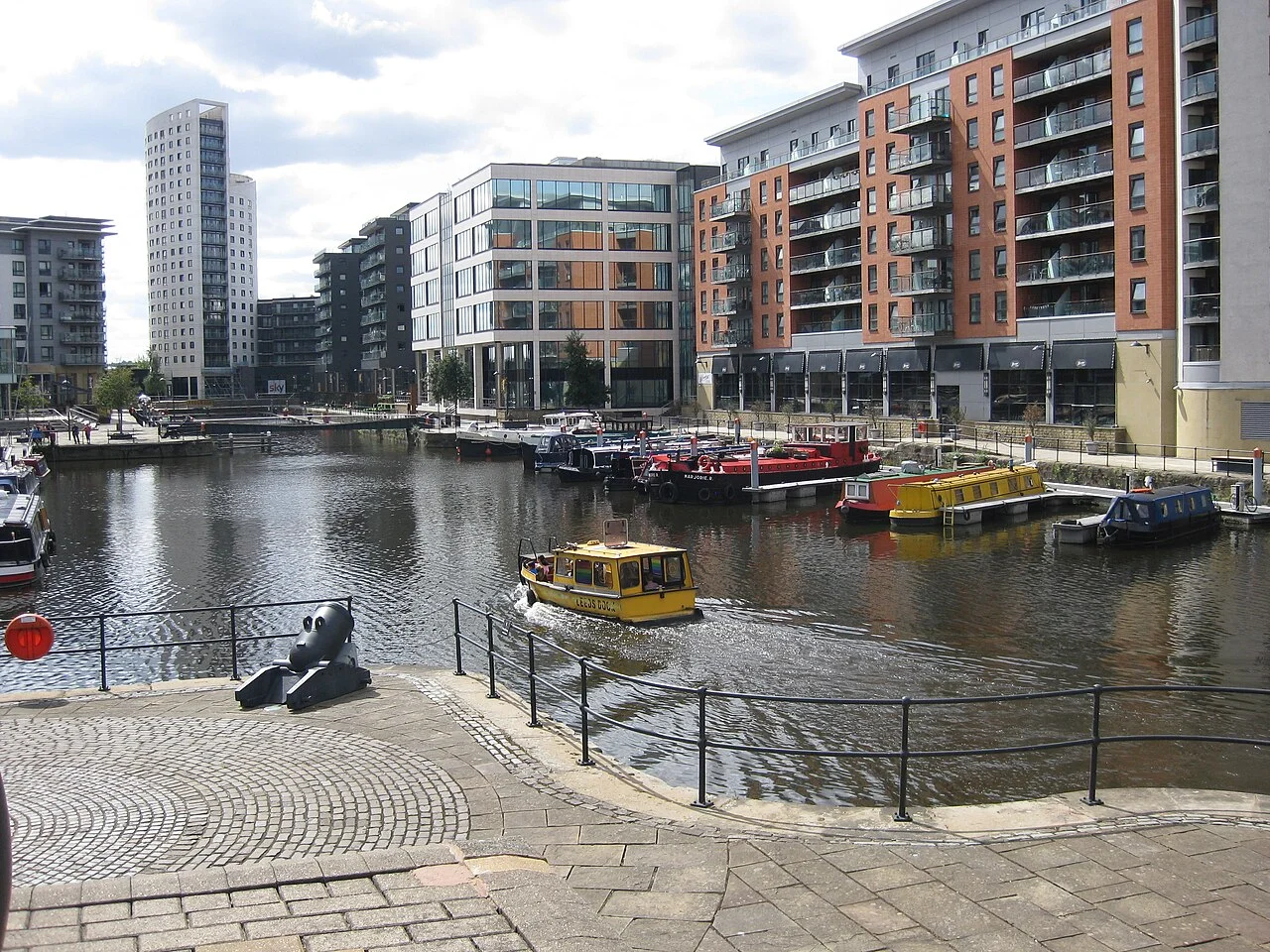
Leeds Dock began life in 1843 as Clarence Dock, a coal basin on the River Aire where cargo was swapped between barges, canal boats and the quayside on the south edge of Leeds city centre. Road haulage emptied it in the twentieth century, the Royal Armouries Museum revived it in 1996, and it has since been renamed twice. Through all of that it has stayed a working mooring, and today the Canal & River Trust runs 20 serviced leisure berths in the basin.
Leeds Dock at a glance
1699–1704 — the Aire and Calder Navigation makes the Aire navigable up to Leeds.
1843 — the dock opens as a coal transhipment basin, later known as Clarence Dock.
Twentieth century — lorries take the trade; by the 1990s the dock is almost idle.
March 1996 — the Royal Armouries Museum opens beside the basin.
October 2008 — shops, bars and apartments launch as a leisure quarter.
2012–2013 — rebranded New Dock, then Leeds Dock under Allied London.
October 2017 — the Leeds Flood Alleviation Scheme brings moveable weirs to the Aire.
May 2025 — the Royal Armouries buys the freehold of its site.
Two waterways and a weir
Two water routes met in Leeds. The first ran east. An Act of 1699 authorised improvements to the rivers Aire and Calder, and by 1704 sixteen locks had made the Aire and Calder Navigation passable up to Leeds and Wakefield. That gave Leeds a water route to the Ouse, the Humber and the North Sea, shortened in 1826 by a new cut to the port at Goole.
The second ran west. The Leeds and Liverpool Canal was promoted by Yorkshire merchants who traded easily eastward but poorly westward; Bradford traders especially wanted limestone brought in and textiles carried out to Liverpool. The canal runs some 127 miles and ends in Leeds.
Between them stood Leeds Dam, a weir across the Aire. Boats bypassed it on a short channel called the New Cut or Leeds Cut, with Leeds Lock built on it in the 1700s. The cut left a river island beside the weir, now Fearns Island, and it was right alongside this that the dock would be dug.
1843: Clarence Dock and the coal trade
The basin opened in 1843 as a transhipment dock: a place where goods were lifted from one kind of boat to another, or between boat and quay. Its main cargo was coal from the collieries around Rothwell and Wakefield, feeding the furnaces and boilers of Hunslet and the businesses of the city centre.
It was built for work, not looks. A large crane ran on rails along the western quay, loading and unloading barges, and the mills, engineering works and warehouses around the basin made this stretch of the Aire one of the industrial engines of Victorian Leeds. For most of its working life it went by Clarence Dock, and many boaters still call it that.
How the dock lost its trade
Railways took traffic from Britain's canals through the Victorian era, but Clarence Dock survived that first wave.
Road haulage ended the argument. Once a lorry could take coal from pit to customer in one move, a dock that required a second handling had no reason to exist. The industry around it faded at the same time, as mills and heavy engineering closed, shrank or left the centre. By the 1990s the basin carried almost no freight and most of its Victorian buildings stood derelict.
The Royal Armouries and the new waterfront
Regeneration started with a national museum. The Royal Armouries Museum, purpose-built for £42.5 million, opened on the edge of the basin in March 1996, bringing part of the national arms and armour collection north from the Tower of London.
The rest came slowly. A multi-storey car park followed in 2004 and a hotel in August 2006. In 2007 the Knights Way footbridge, designed by Buro Happold, crossed the river and Fearns Island to link the dock with apartments on the far bank. Homes rose alongside: Clarence House, a 66-metre tower by the water, holds 227 apartments.
The shops and bars launched on 11 October 2008, weeks into the financial crisis. Few retail chains signed up, and the plan to make the dock a shopping destination never took hold.
Clarence Dock, New Dock, Leeds Dock
The names changed faster than the fortunes. In mid-2012 the site became New Dock. The developer Allied London then bought it and relaunched it in 2013 as Leeds Dock, the name it carries today.
The river since 2017
The Aire around the dock is now managed very differently. The first phase of the Leeds Flood Alleviation Scheme, opened on 4 October 2017, installed moveable weirs at Crown Point and Knostrop — the first use of that technology for flood defence in the UK. Their gates sit on inflatable bladders and can be lowered to let high flows through.
Leeds Dam was refurbished in the same works, and downstream at Knostrop the man-made island between canal and river was removed so the two channels could merge and ease a bottleneck. Leeds Lock still handles roughly 1,000 to 1,500 boat passages a year.
The scheme had been operated nine times by the time of Storm Babet in 2023. This is a managed river, so check conditions and Canal & River Trust notices before cruising through central Leeds.
Leeds Dock today
The retail quarter never recovered and most of its shops have closed, but the museum is doing well, with around 350,000 visitors in 2024–25. In May 2025 the Royal Armouries bought the freehold of its site, in a deal reported at £11 million, to expand its events and conferencing space. It is one of three flagship projects in the regeneration of Leeds's South Bank, alongside British Library North and the new Aire Park.
Mooring at Leeds Dock
For anyone cruising the Aire and Calder or the eastern Leeds and Liverpool, the basin is one of the best-placed stops in the city. The Canal & River Trust manages 20 serviced leisure moorings here under its Clarence Dock L1 Leisure listing, which describes them as follows.
Berths are on floating timber-decked pontoons, with a service bollard between each berth.
Services are a water tap and a 16-amp electric socket per boat, paid through smart meters and an online portal.
Access is on foot only. There is no vehicle access or parking; the nearest car park is about 250 metres away, opposite the Royal Armouries. The pontoon gate needs a site key, issued against a £50 deposit.
Use is leisure only. The site has no residential planning consent, so it is not a liveaboard berth — our guide to residential mooring rules explains why that consent matters.
Two caveats. The Leeds sanitary station is closed, with a temporary Elsan point on site for mooring agreement holders only. And when we last checked, in September 2026, the listing showed no vacancies. Visitor moorings in the dock remain available for shorter stays, subject to the signs on site.
What a berth here is likely to cost
We have not quoted an annual fee for Clarence Dock because none was advertised while the site was full. Canal & River Trust berths in Yorkshire and the North West have recently been advertised at roughly £114 to £230 per metre per year; the regional breakdown is in our UK mooring costs guide.
For a wider view, live MoorHub listings give a local benchmark. Across 20 leisure berths currently listed in Leeds, Wakefield and Castleford, the median asking price works out at about £288 per month.
If Clarence Dock is full
Our guide to finding a long-stay mooring covers how to get on waiting lists and spot vacancies early, and mooring contracts explained covers what to check before you sign.
Looking for a berth near Leeds?
Compare long-stay moorings across Yorkshire by boat length, facilities and availability, and book direct with the operator.
Sources and further reading
The authorities below are definitive for mooring availability, facilities and river conditions, and mooring terms and fees change. Check them directly before you plan a visit or apply for a berth.
GOV.UK — Royal Armouries annual report and accounts 2024 to 2025
BBC News — Royal Armouries in £11m deal for Leeds waterfront site
This article is general information, not legal or financial advice. Where money or occupancy rights are at stake, take your own advice.