

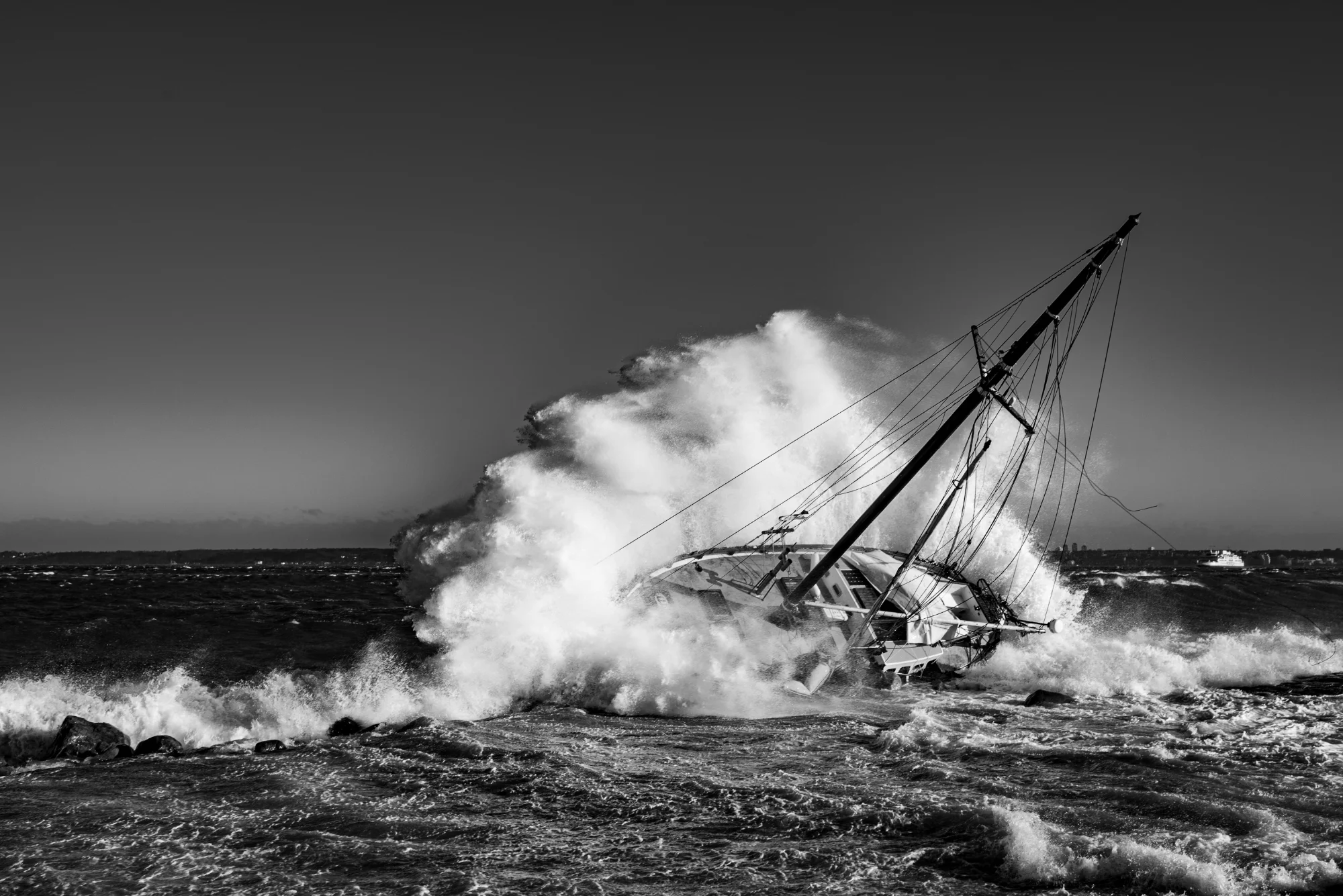
To protect your boat in bad weather, do three things before it arrives: double up your mooring lines and protect them from chafe, strip off anything the wind can catch, and make sure an automatic bilge pump has a charged battery behind it. Then check the official notices for your water, and get off the boat. This guide covers the coast, rivers and canals, how to tell whether a waterway is closed, and what your insurer will want afterwards.
Before the storm: the jobs that apply to every boat
These apply to a narrowboat on a canal as much as a yacht in a coastal marina. Do them a day ahead, in daylight.
Lines. Double them up, so one takes the load and a slightly slacker one stands by. Add springs (lines run diagonally fore and aft) to stop the boat surging along the berth.
Chafe. A line sawing over a fairlead or pontoon edge can wear through in a night. Wrap the contact points in split hose, rags or a chafe guard.
Fenders. Use more than usual, and hang them at staggered heights so the hull is protected when the boat heels.
Windage. Take down biminis, sprayhoods and dodgers, stow loose kit, and check the fixings on covers and solar panels, which behave like sails in a gale.
Bilge pump and batteries. Test the float switch. River Canal Rescue, the inland breakdown service, says most sinkings it attends involve pumps that had to be switched on by hand. An automatic pump only works while its battery has charge.
Drains and openings. Clear deck and engine bay drain holes, and close hatches and windows.
Photographs. Take pictures of how you secured the boat and what is on board, in case you need to claim.
This builds on our winterising checklist, which covers frost and the water system.
On the coast: surge, exposed pontoons and swinging moorings
Coastal storms add storm surge, where low pressure and onshore wind push the sea above the predicted tide. When a gale coincides with spring tides, run lines as high up the pontoon piles as you can.
In a marina berth, lead lines at as wide an angle as your neighbour's berth allows, which reduces the load on cleats. Leave a locker unlocked with spare lines inside: staff who patrol in bad weather can only add a line if they can find one.
A swinging mooring (a buoy the boat swings around) lets the boat face the wind, but everything hangs on one strop. Fit anti-chafe where it passes through the fairlead and rig a back-up line. If the mooring is exposed, move to a sheltered berth or have the boat lifted out while there is time. Our guide to types of moorings explains how pontoon, pile and swinging moorings differ.
On rivers: strong streams and changing levels
Rivers rise and fall quickly after heavy rain, and the danger is usually your own ropes. The Canal & River Trust warns that a boat tied too tightly cannot rise with the water, so it tilts. If it tilts towards the side with the sink and shower outlets or the engine vents, water comes in and the boat can sink. Falling levels are as risky: a boat that has drifted over the bank is left hanging as the water drops.
Leave slack in every line and adjust it as the level changes. There is no safe fixed figure, because it depends on how far your stretch of river moves.
Rising mooring posts and floating pontoons cope with floods far better than a fixed bank. Check they are free to move.
Do not cruise on a strong stream warning. Flows near weirs and sluices are a risk to life.
Keep a safe way off the boat. If the bank is about to go under, leave early and stay elsewhere.
On canals: fallen trees, flooding and emergency stoppages
Canals rarely flood because their levels are managed. When one does, the Canal & River Trust says it is usually where a river has spilled into it. Wind is the more common problem: storms bring down branches and whole trees, which block the navigation and can land on boats. Before a gale, avoid mooring under large trees or bridges.
Afterwards, expect emergency stoppages while the Trust clears trees and reopens flood gates, which can stay shut after the level drops while silt and debris are removed. Report damage on 0800 47 999 47, and do not adjust sluices or paddles yourself.
How to check whether your waterway is closed
These are the definitive sources, as checked in November 2026.
Canal & River Trust notices and stoppages: closures and restrictions on its canals and rivers, with email alerts. Its strong stream warnings page shows flood lock status and river readings that normally update every 30 minutes.
River Thames conditions from the Environment Agency, updated daily. Red boards at locks mean all boats are advised not to navigate. Yellow "stream increasing" boards tell powered boats to find a safe mooring, and yellow "stream decreasing" to proceed with caution.
Anglian waterways (the Nene, Great Ouse and Ancholme): red Strong Stream Advice means do not navigate. Floodline is 0345 988 1188.
Broads Authority boating news and Notices to Mariners for the Norfolk and Suffolk Broads.
On the coast, your harbour authority's local Notices to Mariners. The Royal Yachting Association explains where to find them.
Met Office weather warnings: yellow, amber and red, based on likely impact. Flood warnings are published separately for England, Wales and Scotland.
After the storm, and what your insurer will want
Go back when it is safe. Check the lines, fenders, bilge and batteries, and re-check the notices before you move, because a stretch that was open may now be closed.
If there is damage, insurers broadly ask for the same things:
Stop it getting worse, for example by pumping out or covering a broken window.
Photograph the damage and how the boat was moored.
Tell your insurer promptly. Policies set a time limit for notification.
Make emergency repairs only. The insurer will usually want to inspect first.
Check now that your policy covers weather damage. Our Boat Safety Scheme and insurance guide explains what cover moorings usually require.
Choosing a mooring that copes with bad weather
Where the boat lives decides how much of this falls to you. A sheltered marina with floating pontoons and staff on site looks after a boat you cannot reach. An exposed river bank or a swinging mooring in an open harbour depends on you getting there. When you compare moorings, ask how far the level moves in a flood, whether anyone checks boats in a storm, and whether you can reach the berth when the towpath is under water.
Looking for a more sheltered berth?
MoorHub is bringing UK mooring vacancies, with prices, into one place. Join the waiting list to hear when berths that fit your boat go live.
Common questions
Should I stay on my boat during a storm?
No. Secure it, photograph it and leave. If you live aboard on a river, arrange somewhere to go before the bank floods.
What do red boards on the Thames mean?
The Environment Agency is advising every boat, powered or not, to stay off that reach because the stream is too strong.
How much slack should I leave in my mooring lines?
Enough for the boat to rise and fall without tilting. Ask your marina or neighbours how far the level has moved in past floods.
Will my boat insurance cover storm damage?
Many policies do, but cover varies, so read yours. Insurers can look at how the boat was secured and how often it was checked.
Sources and further reading
The organisations below, and the notice pages linked above, are the definitive source for their own warnings and advice. Check them before you rely on anything here.
Canal & River Trust: preparing for a flood (River Canal Rescue's advice)
Royal Yachting Association: making a claim on boat insurance
This article is general information, not legal or financial advice. Where money, safety or occupancy rights are at stake, take your own advice, and follow the instructions of your navigation authority, harbour master or marina in bad weather.