
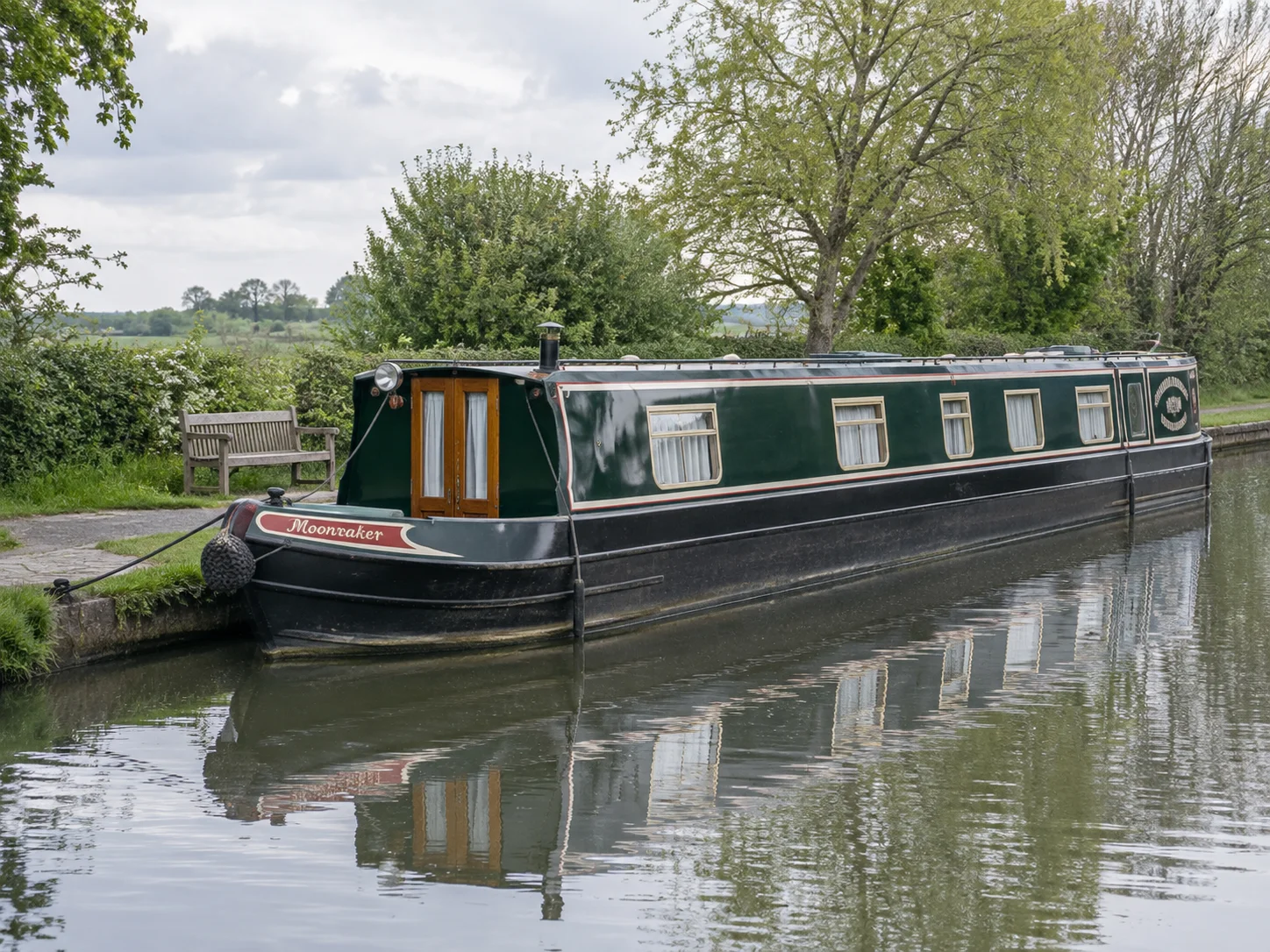
If you are buying your first narrowboat, the mooring decision comes before almost everything else. It determines your licence, your monthly costs, how often you legally have to move, and whether you can realistically work or study in one place. This guide sets out both routes and what each involves in 2026.
The choice: home mooring or continuous cruising
Every narrowboat used on Canal & River Trust waterways needs a boat licence. When you apply you declare either that the boat has a home mooring — a place available to it whenever it is not cruising — or that you will cruise continuously. That single declaration drives almost everything else.
Option 1: a home mooring
A home mooring is a designated base — a canal marina berth, an online towpath mooring let by CRT or a private landowner, or a berth in a basin. You return to it between trips, and you are not bound by the movement rules that apply to continuous cruisers.
What you get: a fixed address for the boat, services on tap, security, and somewhere to leave it while you are at work. What it costs: the berth fee, plus a waiting list at popular sites.
Published marina tariffs put a canal berth at about £55 per foot a year on a twelve-month contract — £3,365 for a 60ft berth at Swanley Bridge Marina from July 2026 — rising to roughly £75 per foot on a rolling monthly one. Region moves it much further: on the Canal & River Trust's own vacancy listings a berth works out at around £130 per metre a year in the Peak District against £341 to £420 in London. See UK mooring costs in 2026 for the full breakdown.
Option 2: continuous cruising
Continuous cruising means the boat has no home mooring and lives on the move, using towpath and visitor moorings around the network. It removes the berth fee, which is why it attracts people, but it is a genuine commitment rather than a licensing loophole.
CRT's guidance is explicit about what it expects:
You must not overstay anywhere. This generally means no longer than 14 days on most of the network or less where signs indicate.
You also have to be on a continuous journey, not shuffling back and forth along one stretch of water. CRT describes the legal test — bona fide navigation — as "genuinely cruising a fair range of the network", and it assesses that by looking at the range between the furthest points your boat has reached over the licence year.
The 14-day rule in practice
Fourteen days is a maximum, not an entitlement: many popular moorings are signed for 7, 3 or 2 days, and those signs override the general limit. Moving a few hundred metres and returning does not satisfy CRT — the requirement is a genuine journey, not a technical change of position.
CRT can also vary movement requirements temporarily; it suspended the 14-day movement requirement during drought conditions in 2026 to help conserve water. Check the current CRT position rather than relying on what was true last season.
What happens if you get it wrong
CRT monitors boat movement and, where it judges cruising insufficient, will typically issue a restricted licence for a trial period of six months. If the pattern does not change it can refuse to issue a further licence without a home mooring, and as a last resort remove the boat from the water.
The cost gap is narrowing
Continuous cruising used to be straightforwardly cheaper. It is still cheaper, but less so: since 2024 CRT has applied a surcharge to boats without a home mooring, phased in over five years.
April 2024: standard fee + 5%
April 2025: + 10%
April 2026: + 15%
April 2027: + 20%
April 2028: + 25%
Standard fees themselves rose 4.85% from 1 April 2026. Widebeams pay a further surcharge on top — 19% for beams of 2.16m–3.24m and 38% above 3.24m in 2026, both rising to 25% and 50% respectively by 2028. Use CRT's licence calculator for your exact figure.
Set against a 60ft berth at roughly £280 a month on an annual marina contract, or nearer £380 on a rolling monthly one, continuous cruising still wins on paper — but budget for higher fuel, more frequent pump-outs, and the time cost of moving every fortnight.
Choosing a canal marina
If you go for a home mooring, the things that actually matter day to day:
Berth dimensions: maximum length, beam and draught, with your fenders on.
Network position: which way you can cruise, and what locks, tunnels and bridges sit between you and the rest of the system.
Shore power: how it is metered, what it costs, and whether the supply is reliable in winter.
Pump-out and Elsan: on site or a cruise away, and charged per use or included.
Access and parking: 24-hour gate access, and a space you can actually use.
Liveaboard policy: whether overnight stays are permitted, and how often.
Works policy: engine running hours, painting, welding and contractor access.
Marina berths cluster where the network does — the Grand Union, Oxford and Shropshire Union canals all carry long runs of marinas — but availability moves constantly, so search by waterway and location rather than assuming a town will have something free.
Common mistakes
Buying the boat before securing the mooring, then discovering local waiting lists are two years long.
Comparing headline berth fees instead of total monthly cost including metered power.
Treating continuous cruising as a way to avoid moving, rather than a commitment to move.
Assuming a marina that tolerates overnight stays permits full residential use.
Buying a widebeam without checking either the surcharge or the navigable range.
Letting the BSS certificate lapse — it is a licence condition, not a formality.
Find a home mooring on the canal network
Compare canal berths by waterway, dimensions, facilities and price — then enquire directly with the marina.
Sources and further reading
Every rule and fee quoted above comes from the navigation authority or government page that sets it. Check these before you commit to anything — fees change annually and licensing rules do change.
This article is general information, not legal or financial advice. Where money or occupancy rights are at stake, take your own advice.